Mavis's Shoe
Author of two novels and a creative memoir.
Thursday, 21 January 2016
Writing on the Road: Campervan Love and the Joy of Solitude
While writing two novels, ghosting two memoirs for other people and working on various other bits and pieces, I needed to escape my hectic household and create some space to do it. As a mother of two and sometime step-mum of four, I realised my only option was to get into a campervan and have it function as a mobile office. It wasn’t long before this had become a habit.
Whether I’m by a beach with buzzards, golden eagles, deer, seals, surfers, other campervanners and dead fish for company, or in the hills around Glasgow, or France, my aim is to switch off the phone, get out the laptop and write.
Writing on the Road is not just funny (or sad) stories of campervan trips in Scotland; it is not just ‘Zen and the art of campervan maintenance’ (with stories of sweetness and light that will entertain or make you cry); and it is not just nature writing (with observations of wildlife in Kintyre, Assynt and other places on the western seaboard of Scotland). But if you enjoy reading about how books are written and about recovery stories from relationship breakdown, or about women travelling alone and all the things that can go wrong (and right), about strategies for facing fear, dealing with creepy crawlies and noises in the night, and about surviving all that life throws at you, then you will probably enjoy this book.
As well as chapters on writing, procrastination, meditation and creativity, there’s information on how (not) to buy a campervan, how to maintain it and what to do if you lock yourself out in the middle of nowhere just before bedtime.
I hope this book will inspire and encourage any would-be campervanners to get out there, get creative and enjoy the campervan life.
I'll be appearing at the Aye Write! book festival in Glasgow in March. Meanwhile watch out for my little van around town.
Thursday, 21 May 2015
Weegie Wednesday
‘Weegie’ is a term of endearment used by the people of Edinburgh for their neighbours in their sister town of Glasgow. ‘Weegie’ is short for ‘Glaswegian’ and Weegie Wednesday is Glasgow’s response to the Edinburgh Literary Salon: Glasgow’s literary salon.
But we prefer to call it a social and networking event. Perhaps because Edinburgh Literary Salon sounds a bit posh and therefore exclusive, (though actually I've been and it's very friendly) Weegie Wednesday, in the style of all good sibling rivalries, emphasises the egalitarian nature of its events. Our focus is on friendship, facilitation and welcome.
We are writers of all kinds including fiction, non-fiction, journalism, sci-fi, graphic novels, screen, stage, poetry and more, but we are also publishers, agents, booksellers, editors, translators and so on. In fact anyone with an interest in publishing and writing would enjoy these evenings. Given that we all have to be multi-tasking polymaths these days, this is handy.
We aim to greet newcomers as they arrive and station at least one committee member on the lookout for the first hour or so. This is to enable people to come alone if they have no literary friends. We also make sure no-one is left by themselves and try to introduce people to one another, especially if they have a particular purpose in being there.
We have either one speaker who talks for 15 minutes or two for 10 each. These are not opportunities for anyone to sell a product, but are about our experiences in our various fields. Previous speakers have included Bernard Mac Laverty, Ian Rankine, Fiona Brownlee, Nicola Morgan, Lesley MacDowell, David Greig and more. Next up, in June 2015, are Rally and Broad.
But the main focus is the socialising. This is the one night of the month when I feel completely sane and meet other writers who live strange lives similar to my own, or I make sense of the mysteries of the publishing world. I feel supported and heard, plus I had the added luck of finding my publisher right there at Weegies. This is so often how deals are done, in person, because you can get a proper feel for how you will work together. Many others have been similarly fortunate at Weegies.
We are so inclusive we even have members who travel through from Stirling, Kilmarnock and beyond. There is even a contingent from Edinburgh who travel through every month and which includes my brother the non-fiction writer Colin Salter. People from as far away as Inverness and Aberdeen have visited us to see how it’s done, and gone on to set up similar events in their areas.
There will soon be a new, more interactive website for Weegie Wednesday, but in the meantime go to www.weegiewednesday.org where you can read our manifesto, officially join or just get more information. Or turn up at the Terrace Bar in the CCA 350 Sauchiehall Street Glasgow G2 3JD after 7.30pm on June 17th and ask for me.
A quote from happy attendee: 'The atmosphere is incredible, the people are great and it’s fantastic to have such a great venue full of similarly-minded people.'
Monday, 11 May 2015
Spiral writing
One of the funnest ways to get new ideas going is OuLiPo. I think I've written about OuLiPo here before. It stands for Ouvroir de Littérature Potentielle or Workshop of Potential Literature. The main idea is that by restricting how you write, you release more possibilities. It's a hybrid of literature and mathematics, or at least arithmatic. Many OuLiPo exercises are quite simple and therefore very satisfying, for instance 'the snowball'. For more information on OuLiPo techniques follow this link

However my favourite OuLiPo exercise is the 'Spiral', see above, which I believe is based on a theory by mathematician Pierre de Fermat, though I haven't been able to prove that.
Choose six words at random and assign them a number in order of how they were chosen. Then write a story using the six words in the orders indicated in this diagram. The six words are spiralled to produce a new order each time. The next six begins with the last word of the previous six and spiral as indicated. This obviously means every so often one of the words is repeated in close proximity, but also, all the words appear seven times in total, creating a consistency of sound and a tightness of meaning.
This exercise poses a fun challenge and doing one loosens up the muse. The mathematical beauty of arriving back at the correct order is also very pleasing. The real trick is to make the words blend so well the reader doesn't realise what is going on. This isn't always easy and depends on the words which appear and the skill of the writer.
It may be that no great literature is created in this way, but possibilities are definitely opened.
I offer you here a spiral I wrote prior to a recent writing workshop in Timespan Museum and Arts Centre in Helmsdale. For some reason the existence of Paddy McGinty's Goat by Val Doonican came to mind that morning.
See if you can find my six words. They came, at random, from this book: 'Exploring Scotland’s Heritage – The Highlands'.
~~~~~~~~~~
Our home was more of a fort than a cosy family dwelling. An ex-church built of heavy stone with tiny windows, its pulpit, which sat at one end of the dining room, was its most un-endearing feature. It lectern was McGinty’s favourite spot in the house, McGinty being our goat.
One day, McGinty ran off and after hours of wandering the roads in search of her, we walked home shouting her names:
‘McGinty!’
‘Paddy!’ That was her other name. We made up new names for her too:
‘Slit-eyed bandit!’
‘Daughter of a whore!’
‘Wilhelmina!’
At last, weary and frustrated, we returned to the fort, aka home. The roads seemed to have jumbled themselves up, so it took us a while. How we regretted chasing McGinty from her pulpit and out of the house. How we simultaneously hated and loved each tiny feature on that hairy face. But in particular the feature of her left eye which was damaged and always stared straight ahead.
She knew all our names too, so on the way back home we called those instead of hers because darkness had fallen and we were afraid.
The fort loomed in the gloom. We raced to the pulpit full of hope only to discover beneath it a pile of lettuce leaves, a carrot and two turnips she much have stashed there. How we wept, imagining our neglect and her toiling alone on the roads.
So after a hearty dinner of goat’s cheese dumplings and turnip soup, we donned sheepskin jackets, took torches from the cupboards and set off for the higher roads up the mountain.
We shone our torches in our faces and laughed as each feature swam across the others. We stood on rocks and brayed like McGinty on her pulpit, reciting our names in goat for her understanding. We passed other forts like ours, house after house, light spilling from within onto the roads. No fort was as dismal as ours.
As we grew tired again and the birds fell silent in the trees, I realised the best feature of our home was McGinty herself and the way she knew the names of all the vegetables she wasn’t meant to eat.
‘Don’t eat my broccoli,’ I’d say and she’d go straight out to the garden to eat it, then race back to the pulpit to preach from that same pulpit to this idiot who stood below berating her and demanding she descend. If goats could laugh …
So, as we passed the last house we called her new kinder names.
‘Sweetpea!’
‘Munchkin!’
‘Adorable!’
Then there were no more roads. We sat despondent against a tree and listened to the silence. Then suddenly we saw one eye in the darkness, that one feature I so hated but now loved with abundance, and then another beside it which blinked. She fixed me with these as I yelped for joy, as did we all. She stood motionless and waited for us to come. We fixed the rope around her neck to bring her home to the fort without mishap.
But she would not budge.
‘The fort, my sweet …’ we said, ‘and your pulpit that you love so much. Come home, please, pretty please.’
We cajoled, we argued. But she turned away from us and yanked us behind a rock, a feature we hadn’t seen in the dark.
Six little eyes with tiny slits gazed up at us, three little mouths brayed.
We tucked them under our arms and lead McGinty, lamb-like, back to the house by the twisting winding roads and as we walked we chose names for her three little kids.
‘Makushla.’
‘Pushkin.’
‘Doonican.’
Sunday, 26 April 2015
Govanhill Gazette

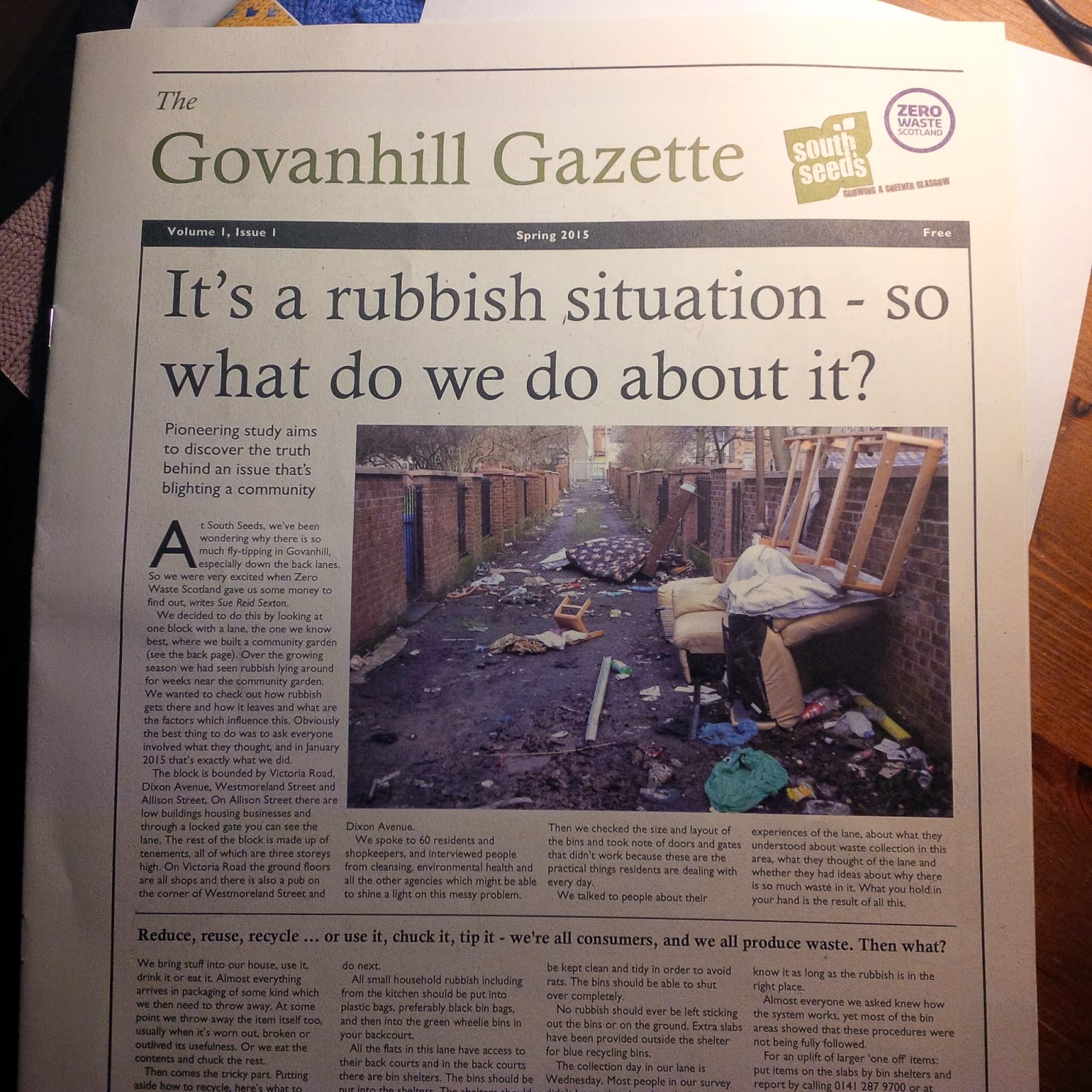
In case you thought all I've done this year is muck around in a campervan in the north of Scotland, I have to tell you about the Govanhill Gazette. In January this year I was asked by wonderful South Seeds, a community environmental organisation in the South Side of Glasgow, to research flytipping in a particular back lane in Govanhill. A mucky job if ever there was one.
Wearing walking boots and clothes designed to fend off any bugs that might want to hitch a ride with me, I toured the lane and documented all that went on there rubbish-wise for a month. I also interviewed over sixty people and spoke to all the organisations and powers-that-be in the area who might have an interest or bring some light to bear. These included the cleansing management and the bin-men themselves, various support organisations and agencies, and as many residents as I could find. The above publication is the result, almost all of which was written by myself, not including the headings. My accomplices in the final production were Lucy Gillie, project manage of South Seeds, and Sam Bartlett, a journalist and South Seeds volunteer who used to work for the Herald newspaper.
Our aim was to simply state what people were saying without casting judgement or offering solutions. By literally just sharing everyone's views we hope to facilitate some communication and understanding, and perhaps thereby give people the opportunity to make real change. What I found was not what you'd expect. There were no obvious demons and no obvious angels either. Much of the problem stemmed from misunderstandings, misinterpretations, faulty or no information and obvious human problems. It's an eight page easy read and so far has been very well received.
If you'd like a copy, get in touch with South Seeds at www.southseeds.org or visit them at their office in Butterbiggins Road. They also run lots of other community environmental projects including offering free energy audits for your house to help reduce bills and community gardens in various locations offering opportunities to get your hands dirty in a cleaner way than I had down the lane.
But it's not all bad. Here are Louis, Ruskin, Casey and Sam, (from L to R) four of the South Seeds team at the Glasgow Awards Ceremony this month where South Seeds picked up the award for best community initiative. I think a prize was also due to everyone for more or less managing the 'black tie' attire directive stipulated on the invite. Those who should be specially named in this respect are Robin and Uillie, with Maureen, Lisa and Lucy all as effortlessly gorgeous as ever.
PS Here's a link to an online version of The Govanhill Gazette
New Northern Frontiers

Apparently I'm to be allowed to keep this lovely thing, a giant photograph of my beloved camper in its Possible Scotland regalia. The photo of me and it was taken at the New Northern Frontiers event on Friday 17th May at the Lighthouse Glasgow, organised by Lateral North. There's a link to the livestream of the evening here. In part 1 there's a fabulous presentation by Andy Wightman, author of The Poor Had No Lawyers, and in part 2 near the end I do a swift run through the Possible Scotland trip I did with Graham Hogg of Lateral North in March, much of which I've covered elsewhere on this blog. There were also other great speakers including the Scottish Rural Parliament, Dualchas Architect (Dualchas translates from the Gaelic, roughly, as cultural heritage), Timespan, Arctic Alba and Highlights Arts. Unfortunately we ran out of time so Graham had only one minute to tell all about our great plans for the future. Instead you can read about it here.
Thursday, 16 April 2015
One more thing about Possible Scotland
However, I was not detered. Tomorrow night at the Lighthouse Museum in Glasgow there is an event called New Northern Frontiers. Lateral North and myself will be talking briefly about how our trip went and inviting ideas for a future extended excursion with workshops galore. Andy Wightman, who wrote the wonderful The Poor Had No Lawyers, will also be there. So will Gemma Lord, a northern frontierswoman. Please join us.
Sunday, 8 March 2015
Things I bet you didn't know ...
In no particular order, fascinating facts from the Lateral North trip:
There is talk of a tunnel between Mainland Scotland and Orkney. Not only that but it is financially viable and would be paid off in ferry savings within 9 years.
People in Tongue have the same number of tongues as the rest of us but like to turn up at Lateral North gatherings and waggle them more than most.
The local nightclub in Thurso is called Skinandi which means ‘shining one’ in Norwegian.
At least two thirds of all Lateral North attendees in this area were women.
We visited one school with ten pupils only one of which was a boy.
The Applecross road is sometimes closed with no apparent reason …
The people of Shapinsay want to be linked to mainland Orkney by a tunnel or causeway. The people of Tongue and Melness want to dig a trench so they can become an island.
All roads lead to Lairg except the A9 which leads everyone away.
We saw many rainbows and on one occasion became the pot at the end of it.
Inverness is the fastest growing city in the UK.
True North conference was about documenting the past, present and future but no-one to my knowledge, apart from Lateral North, did the latter.
Everything Andy Wightman said about disenfranchisement of people by large landlords is true.
Borgie Cabin is a giant log cabin made of giant logs, would be suitable for giants, and is in the middle of the woods near Tongue and a very long way from Applecross. You can stay in very cheaply and experience big starry skies.
There is a traditional church bell in Helmsdale still sounding every quarter of an hour.
Leibster was the third largest herring port during the herring boom after Fraserburgh and Wick, despite being a wee village of only 400-500 people.
Orkney has full employment.
Two girls escaped the plague in Perth by hiding in the woods but were unfortunately sought out and discovered by their boyfriends who didn’t realise they were infected and all four lovers died.
Highland moos are the only coos legally allowed to keep their horns in the UK.
Budget Inverness are heroes who fixed the broken exhaust on the van swiftly and for nothing.
Subscribe to:
Posts (Atom)